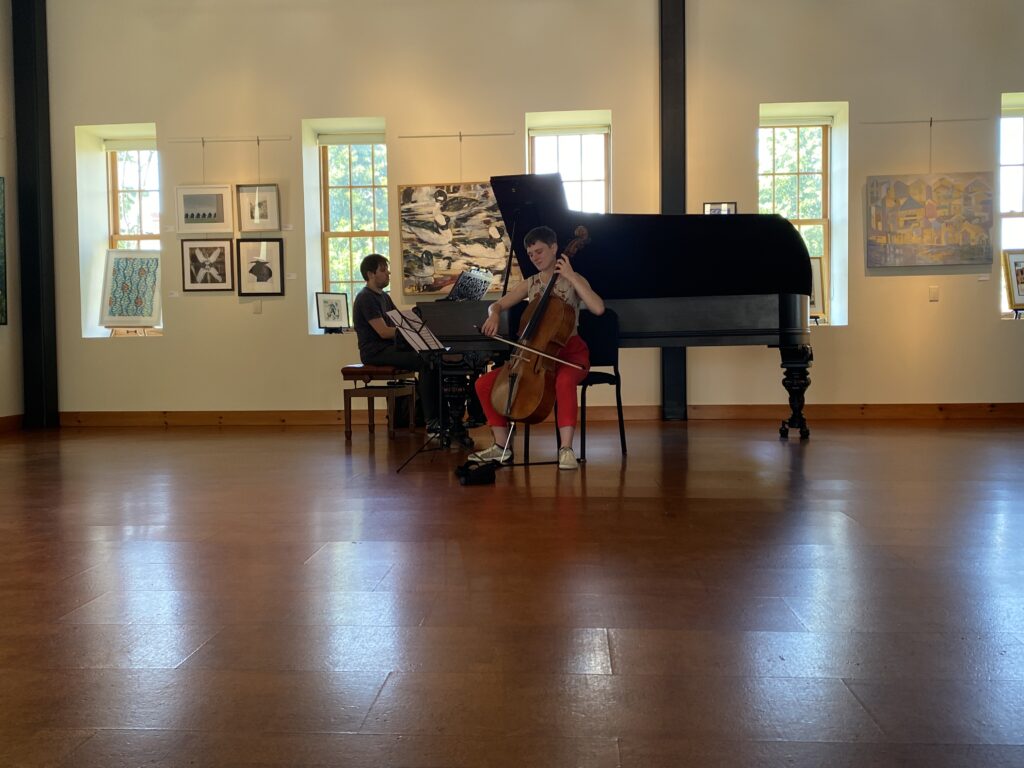
If you walked near our building the past two days, you might have heard music echoing out towards the harbor. Octavie Dostaler-Lalonde and Artem Belogurov are here at La Grua Center for a concert on Saturday, July 16, and they are hard at work practicing to deliver an outstanding performance. We sat down with them and talked about the connection between Gottschalk and Saint-Saëns and what it’s like to perform at La Grua Center. Here is an excerpt from that conversation:
What first got you all into music?
AB: In Odessa (Ukraine) where I grew up, we had a piano at home and I made the fatal mistake of learning how to read music when I was about eight. I then somehow managed to convince my parents that I should be going to a music school and I just got hooked. Initially I was mostly interested in composition, but I learned to play the piano too and turned out to be a little bit more practical down the line.
ODL: When I was 5 years old, my dad asked me what I wanted for my 6th birthday: I replied that I wanted a violin. (Apparently I had just recently seen a violinist play live somewhere and had been fascinated) My parents were surprised and said that if I were to receive a violin, I would need violin lessons, and that I would have to practice every day, and that it wouldn’t all be fun and games and would require effort… to which I said: yes, that’s what I want! I had my first violin lesson on the 21st of October that year, on my 6th birthday.
Who/What inspired you to make music?
AB: We had a collection of records of old soviet musicians, some jazz and Beatles too. Those were definitely inspiring. Nobody in my family played an instrument, although my grandmother sang quite well. And apparently my grandfather was very musical, but he died the year I was born, so that couldn’t have been transmitted directly. His genes probably helped, though. Later, in my teenage years, I discovered early recordings – Rachmaninoff and Kreisler were among the first ones I heard. If there is one general source of inspiration, it’s definitely performers from the Romantic era.
ODL: There was always music playing around the house when I was growing up. My grandmother on my mother’s side played piano, some of my uncles and aunts played jazz and baroque music respectively, we had a jazz pianist and a viola da gamba player as neighbors, whose playing I could hear through the ceiling and the walls – and my father was a passionate music-lover. It was especially through his love and knowledge of classical music, and his regular listening to recordings, that I developed my own sensitivity for it. It was a very important aspect of my development as a musician to be able to have conversations about what I would learn or experience with an understanding father, who in turn would share his own discoveries by buying CDs and recommending artists. We would even sometimes make trips to the discothèque in Montréal to borrow CDs and expand our knowledge of repertoire and performers.
On Saturday July 16, you’ve planned works from American composer Gottschalk and French composer Saint-Saëns. What is the connection between the music for that afternoon?
AB: It does at first seem strange – what do these two have in common (apart from both being pianists and living at the same time)? The starting point for us was the fact that both Saint-Saëns and Gottschalk studied with the same piano teacher in France, Camille-Marie Stamaty, himself a disciple of Kalkbrenner, a famous virtuoso and pedagogue of German descent. This is particularly fascinating because Saint-Saëns left many recordings, while of course Gottschalk died before the age of recording. So from a performance practice perspective this opens somewhat of a window on what Gottschalk’s playing could have been like. Another valuable source is Teresa Carreño’s piano roll recordings. She was Gottschalk’s most accomplished student and the only one I know who made recordings.
ODL: Gottschalk and Saint-Saëns both were well-traveled musicians. They spent extended periods in far away lands and cherished their encounters with cultures very different from their own. They both took inspiration in the musical traditions of those cultures. Saint-Saëns traveled extensively: during his adult life he undertook about 179 trips. He regularly traveled to Egypt and Algeria, but also visited other Northern African countries, South America and Eastern Asia, in addition to Russia and European countries.
You both just finished up a live recording session with Postscript. Tell me about the recording and the group.
AB: I’ll start with the group. Postscript was formed in Amsterdam in 2018 by Octavie, me and our two dear friends Aysha and David, who both play historical flutes. This is a fairly unusual line up – flute, violin and basso continuo (harpsichord and cello) is much more common. The combination of two flutes is really beautiful, though, and in some ways more coherent sounding (no balance problems, for example). From the beginning we thought of Postscript as both a group of just the four of us, where we play 17th- and 18th-century repertoire, as well as a flexible ensemble that on occasion can get as large as an orchestra. Since then we’ve done many different projects as a quartet, trio, and septet and collaborated with singers and even actors in melodrama performances. Our first CD came out in 2019 and we just recorded our second, to be release later this year.
ODL: This second CD is in some way our pandemic project: during the first long lockdowns, the four of us were in Amsterdam, and sometimes the only people who we were allowed to spend time with outside of our living “bubble” were each other, since we were a professional team. Since we were in the temporary impossibility of traveling, we decided to rediscover the city where we now live: Amsterdam. This project is our way of investigating the history of our city: it was an important center for music publishing in the 18th century, but the music published and written there is rarely performed today. The first task was therefore to search the catalogues of those publishing houses and find the scores of music written for flutes, cello and harpsichord in various combinations. We then met and read through what was found and selected our preferred works. Aysha learned to build a flute, and made one for herself based on an 18th-century Amsterdam model. We restored and regulated one of the only surviving Amsterdam harpsichords, and I borrowed a baroque cello by Pieter Rombouts, also made in the city in ca.1690. We finally recorded it in front of an audience last month.
When you’re not performing for people all over the world, you also have a video blog called Romantic Lab. What is your goal when imitating historical recordings?
ODL: As you may know, performing styles have changed in very fundamental ways throughout history. Historical recordings expose this fact, and are a window into how people performed music right at the end of the Romantic era. What we can observe when listening to them is that musical notation alone is very ill-suited to reflect how music is actually played; what is on the page remains a sketch of the musical possibilities. Over the course of the 20th century, we lost touch with that idea, and became much more literal when it comes to interpreting the musical text. What Artem and I wanted to do was to learn to play in a Romantic style, and the most effective way to learn any style remains aural – through imitation. Imitation is central to musical education: musicians imitate their teachers, their colleagues, their stand partners in orchestra, recordings by contemporaneous musicians. Since the people who we wanted to learn from are not around anymore, we had to imitate their recordings in order to learn from them. Therefore, imitation is just a step in the process of developing new expressive tools that fit best the Romantic language.
After your performance at La Grua Center, what’s next for you?
AB: I’m lucky to be staying around in beautiful Stonington for a few days to record a solo CD of Gottschalk. Christopher Greenleaf will be doing the recording, so I’m in good hands. This will be a second CD in the series of American Romantic piano music – the first was dedicated to the Boston scene. Next for me is a trio concert with Postscript’s Aysha and Octavie in Brugge, Belgium, followed by two performances with PS as a quartet in Kircheimbolanden, Germany for the opening of a newly restored Baroque garden. Later in August I have eight concerts at the biggest early music festival of Europe in Utrecht, where Octavie and Aysha are joining for some of these concerts. August will be busy…