
How did you get started in music?
Misuzu: Though my parents didn’t play any musical instruments (mother took lessons for some time, but was mostly found in the playground instead of being at her teacher’s studio!), there was always music everywhere in the house. My father really liked to listen to vocal music and opera. One day, my mother’s friends overheard me singing Baa Baa Black Sheep and pointed out that I had a good sense of pitch, so my mother decided to enroll me in piano lessons. Since then, my joy for music grew through playing in piano duets, ensembles, and chamber music.
Maksim: Both of my parents are not musicians but my aunt on my mother’s side was a professional pianist. She would sometimes come over for tea and chat with my mother. I believe during one of such visits she decided to check if I have a sense of pitch. I guess I impressed her enough that she persuaded my mother to take me to the music school. My first woodwind instrument was a recorder. Back in the 80’s, a child who wanted to study one of the orchestra’s wind instruments would usually learn to play a recorder for a year or two while the body is growing and finally he or she can hold an oboe or clarinet and cover the tone holes and reach all the keys. So when my time came to select the instruments, I actually wanted to play the saxophone. My father loves jazz music and I was exposed to the sound of saxophone records on an almost daily basis. Unfortunately, the best music school in Minsk had no teacher of classical saxophone, and my parents were advised to have me try the clarinet since both instruments are relatives, and if I ever wanted to I could switch or double on the saxophone later. The clarinet took over my life and all thoughts about playing saxophone quickly vanished from my head until I reached my 30’s and graduated from The Juilliard School. But that’s entirely another topic.
A clarinetist from Belarus and a pianist from London: How did you first meet and what brought you together as a musical duo?
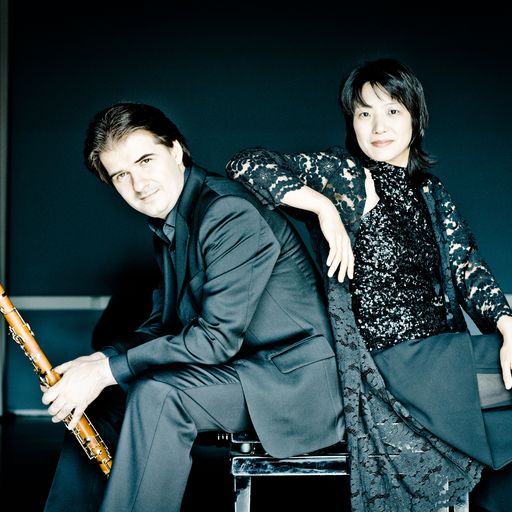
Misuzu and Maksim: We knew of each other at Juilliard but never had the chance to talk to each other. However, we had added each other as Facebook friends. One day, I made a post asking about an immigration lawyer for my visa, and Maksim happened to reply to it. We started talking about everything else under the sun, too, and clicked immediately! During this time, Maksim also happened to be in need of a pianist for a Christmas concert he was organizing, so he invited me to play with him. Since then, we’ve been making music together and have been happily married since 2019.
Last time you were here as a duo, you recorded Schumann for our virtual concert series. How was recording at La Grua Center during a pandemic? What are your thoughts about having an audience this time around
Misuzu: It was a pleasure to be recording in a safe and secluded place such as the La Grua Center and to be away from the madness for a day and focus on our art during those troubling times. Like most artists, we perform differently when in a recording session and when on stage; I have to say that we both prefer the immediacy of a live performance, so we are very much looking forward to this upcoming concert.
Maksim: When Christopher Greenleaf, a remarkable sound engineer and a friend of ours for many years, reached out to us right in the midst of the pandemic with an offer to record a program at the La Grua Center with its fine acoustics and a stunning 1886 Chickering concert grand piano, we felt like someone in a pitch dark room just turned on the lights. We already knew the space from performing there on several occasions. The only question was what the theme of our recording would be. The imaginative musical world of Robert Schumann with its ability to transport the listener to fantastic places outside of the walls of one’s dwelling, even for a short while, is what we felt like playing and sharing with the world in lockdown. This time we are performing live, which is, of course, our most favorite way to share music and we are very much looking forward to reuniting with our dear audience.
It hasn’t been that long since you’ve played here and on the Chickering (Homage to Bach, March 2022). What is it about our space that keeps coming back? (besides us wanting you to perform here!)
Misuzu: The acoustics of the La Grua Center and the peaceful location of Stonington are wonderful, but the main attraction is the Chickering concert grand; the wide range of colors that one can get in each register is spectacular, and Christopher’s constant care and dedication for the piano makes us look forward to the next transformation the instrument undergoes.
In this program, in addition to a traditional clarinet you’ll be performing on a rarely played basset clarinet. What’s the difference and what should the audience be listening for?
Maksim: The basset clarinet has an extended range down to low C (concert A), a major third from the low E the standard for soprano clarinets. This instrument is most commonly associated with several masterpieces by Mozart, including his final instrumental composition the Concerto in A, KV622. For our concert, I made an arrangement of Schumann’s Fünf Stücke im Volkston op. 102 (Five Pieces in Folk Style). The work was originally composed for cello and the extended range allows me to play this work on the basset. I think, even without trying, the audience will immediately be drawn to the remarkable sonority of the low register of the basset clarinet.
You were just in Walnut Creek, CA and then Nova Scotia for a concert series, and now you’re in Connecticut (again). What’s next for your duo?
Misuzu and Maksim: In November, we will be playing two concerts on Long Island and then the week of Thanksgiving we will be going to Tokyo for our first concert there. It has been 10 years since Misuzu set foot on her “homeland”, so it will be a very meaningful trip.