
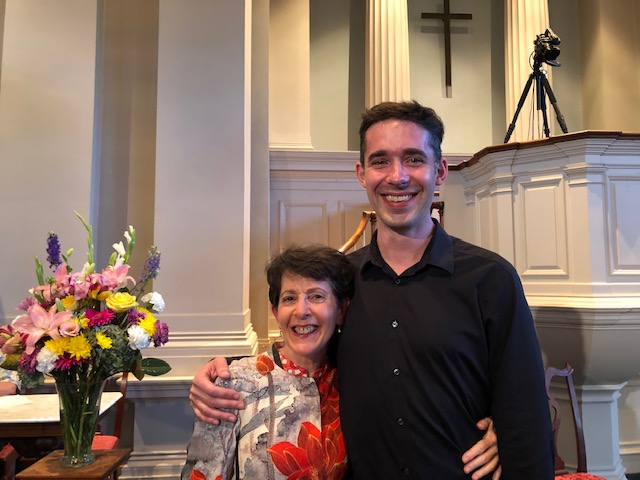
What first got you into music?
Andrew: My older siblings took piano lessons and practiced on our Mom’s old upright. She would also occasionally play, and my dad took lessons too, so I grew up hearing piano music from a very young age. My parents also had some really great classical LPs that I must have heard. (I was too young to work the record player!). Although I started piano lessons when I was eight, it was a concert I went to when I was eleven that changed my life. It was a recital of Chopin’s music, and I was completely mesmerized. That night I stayed up listening to almost all of the Chopin recordings we had and from that point on I practiced and practiced and spent every dollar I could earn down the street at the sheet music store. I was completely hooked!
Julia: A Steinway grand piano came into my home when I was 4 years old . I was immediately drawn to it and began to pick out little tunes as soon as I could, with help from a babysitter. I had to wait until I was 7 years old for formal lessons. When I was in high school I told my mom that I needed a better piano teacher. She found a wonderful teacher for me. I always heard classical music in my home, whether it was the radio or my dad’s records.
Who/What inspired you to become a musician?
Andrew: This is a difficult question! There are so many people, events, and experiences that led me to become a musician! There was a slow simmer of things, but again, there was a concert that solidified things for me and propelled me forward. When I was twenty, I heard a faculty concert one summer evening at the Bowdoin International Music Festival, including a performance of the Schumann piano quintet, and that was a powerful impetus for me to pursue things ever more seriously. I am so grateful to have heard such inspiring performances and am constantly surprised and amazed at how powerful and life-altering music is!
Julia: I wanted to share my love of playing the piano and for music with others. I naturally get along well with people, so teaching was a good fit. I love the thrill of performing and giving people joy and a safe outlet for all of our complex human emotions. Music is the most basic art when it comes to sharing feelings and beauty. It is a universal language and a tremendous force for healing in the world. I feel honored to contribute to this through teaching and performing.
What’s your favorite musical moment?
Andrew: It depends on the moment you ask me! There are so many to choose from, but one of my favorite composers is Robert Schumann, and I love how creative and warm and unabashedly honest his music is. He was not afraid to put his deepest feelings right there on the page, and it is that vulnerability about his music that I find so utterly beautiful. To be vulnerable takes tremendous courage, and I admire that very deeply.
Julia: There are many wonderful musical moments in my life. In high school, I sang alto in a community chorus when we performed Handel’s Messiah. That is a glorious piece of music! I have been able to perform many gorgeous chamber works, including Dvořák’s Piano Quintet at La Grua Center in 2019. Among other highlights are performing Schubert’s “trout quintet for piano and strings, playing Schumann’s piano quartet and quintet, and Mozart’s piano and wind quintet.
What is it about these pieces from Brahms and Dvořák that make it so technically demanding? Is there anything the audience would be surprised to learn?
Julia: There are so many technically demanding parts to the music Andrew and I play together. It is always exciting to execute leaps on the piano in very fast speeds. The Brahms-Haydn Variations we will perform at La Grua Center is full of those moments. When we play one piano together, there is the choreography of our hands, arms and torsos to manage. The beautiful Legends by Dvořák require frequent tempo, character, and dynamic changes. It is also a challenge to pedal for two people! We pianists are quite used to pedaling for ourselves. When we pedal for two (duets at one instrument), we need to attune our ears to what both of us are playing.
How do you prepare these types of arrangements?
Julia: Andrew and I each learn our own parts and then spend a lot of time rehearsing together. This is a real joy- to discuss and negotiate all aspects of the music, from the physical to tempi, dynamics, mood, etc. People don’t often realize that we also discuss how much time to take between movements or variations. We strive to keep the pieces cohesive and interesting, even though they are comprised of shorter sections. All of our pieces for our La Grua Center program are in shorter movements, variations or waltzes. We bounce ideas off of each other and come up with a plan. We are lucky to have 2 pianos in Andrew’s studio on which to practice the Brahms-Haydn Variations.
What’s coming up for you after this performance?
Andrew: Julia and I will continue to happily collaborate on one and two pianos. Danish soprano Julie Reumert, another colleague of mine, and I are in the process of recording an album of songs by Carl Nielsen. I am also working on much of Gabriel Faure’s chamber music in anticipation of the hundredth anniversary of his death in 2024. Like Schumann, he is a composer very dear to me. This past summer, I performed his piano trio and second piano quartet, but there is much more to explore.
Julia: As Andrew mentioned, we will joyfully continue our collaboration together! We will learn the rest of Dvořák’s Legends, as we are only performing the first six at La Grua Center. We will certainly learn some Schumann works, too. I have concerts coming up with my good friend and colleague, Irwin Reese, a retired Metropolitan Opera chorus tenor. We have been happily collaborating for 13 years and will give a concert at Riverside Church in Manhattan during Black History month (February), as well as playing in Montague, MA and in North Carolina.